
Multisensory Architecture and Healthy Environments
“I believe we need to expand our design palette to use it to stimulate all of our senses” - Tye Farrow

Interior photograph of Lauremont School Bayview Campus entrance building, Photographer: Tom Arban
Sander Schuur and Jeffery Murray of PGH Platform host Tye Farrow for a conversation on enriching environments and multisensory design. The international conversation series opens dialogue between architects, designers, planners, and public health professionals to discuss the shaping of a healthy built environment. Within the conversation, Tye Farrow takes care to highlight the sensory discrepancy that exists within architectural practice:
“When we design buildings, we make computer renderings to see what it looks like. We do material boards to see what it feels like – the difference between holding a wood, leather or steel door handle for example - one takes temperature away from you and the other gives it. It’s the importance of touch in experiencing our surroundings.
But do we make sound boards in architectural practice? No, we don't. We focus on noise, but we don't focus on sound. What about scent, like the smell of cedar? I believe we need to expand our design palette to use it to stimulate all of our senses.”

Detail photo of timber mosaic at Sechelt Hospital by Farrow Partners and Perkins + Will, Photographer: Latreille Delage Photography
In The Eyes of The Skin, Juhani Pallasmaa details how vision is synonymous with knowledge and truth throughout history, even being defined as the most important sense during the renaissance[1]. Pallasmaa goes on to credit the lack of bodily awareness and sense of inhumanity that exists in contemporary architecture to such ocularcentrism[2]. The inexhaustive nature of sensory design in architectural practice leaves a gap in our psychological and physiological capacity to engage with our surroundings. By intentionally designing for all the senses, architecture is capable of generating a healthy environment for the human body to thrive.
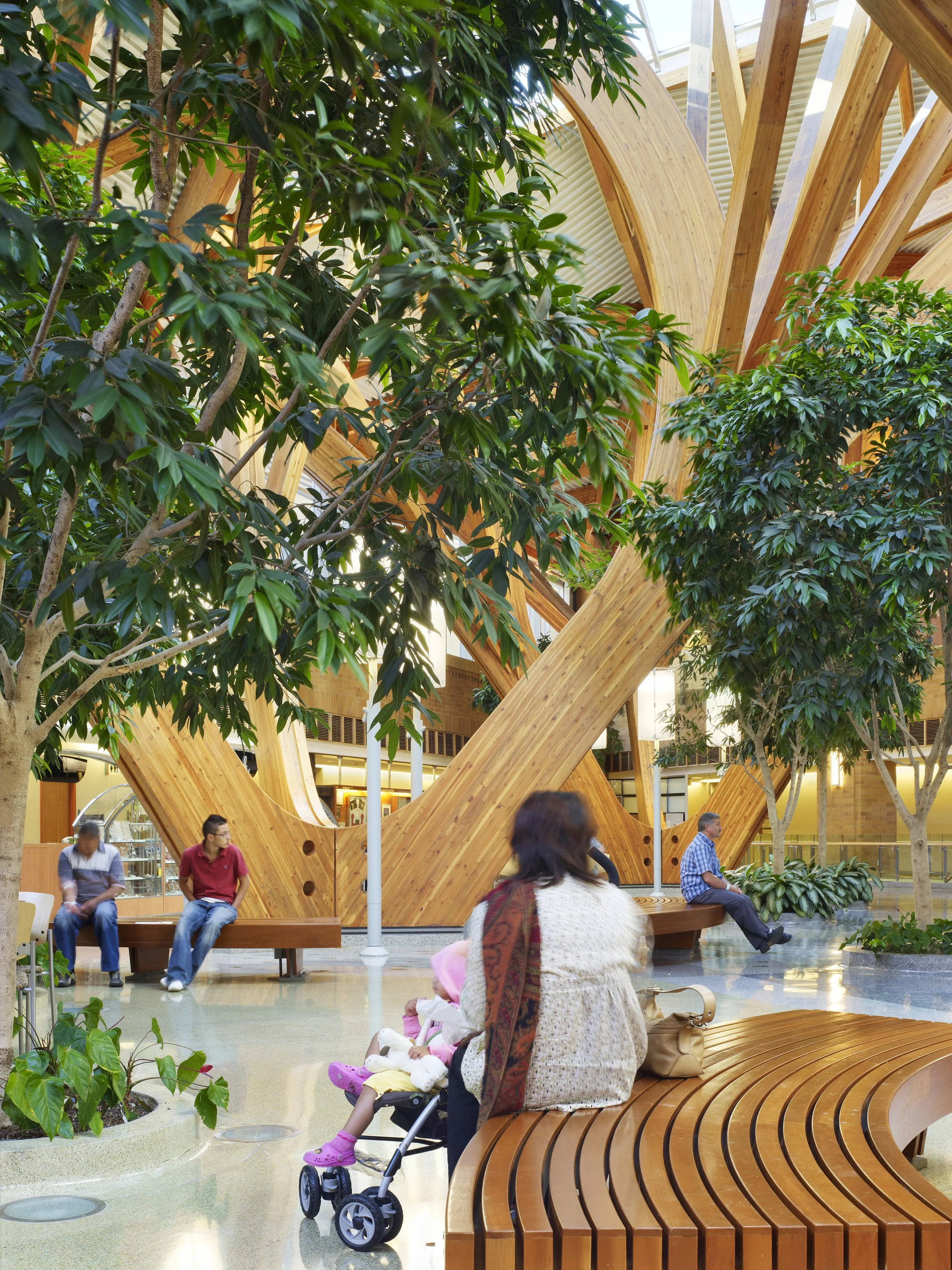
Interior photograph of Credit Valley Hospital, Photographer: Tom Arban
A pleasurable auditory experience, for example, can be accomplished through acoustic design and material selection so as to control noise and reverberation. Sound frequencies and external stimuli have the ability to affect your brainwaves, most prominently studied in relation to music[3]. Beta waves are brain waves that activate when active and concentrating, an excess of which leads to stress, and alpha waves are brain waves that activate when relaxed, often associated with daydreaming and sleeping[4]. Acoustic design, such as wood panels and sound absorbing surfaces, are proven to lower beta waves and increase alpha waves, generating an emotionally grounding, relaxing, and comfortable environment[5].
A meta-analysis published in the Journal of Wood Science in 2017 reviews the physiological effects of wood on humans and found that sensory intake from the material delivered olfactory, auditory, tactile, and visual stimulation[6]. Pine, cedar, and cypress were found to have reduced blood pressure and cortisol levels from olfactory stimulation in addition to calming theta and beta waves due to auditory stimulation[7].
Multisensory architectural design causes deep and meaningful connections between the human body and the environment. Architecture has a responsibility to ensure that this connection breeds health and wellbeing. Salutogenic approaches to design ensure that the built environment fosters a beneficial relationship between us and our surroundings.
To read the full conversation between Tye Farrow, Sander Schuur and Jeffery Murray of PGH Platform, see here.
[1] Juhani Pallasmaa, The Eyes of the Skin: Architecture and the Senses, (John Wiley & Sons Ltd, 2012), 11.
[2] Pallasmaa, The Eyes of the Skin, 11.
[3] Domantė Kučikienė and Rūta Praninskienė, “The impact of music on the bioelectrical oscillations of the brain,” Acta Medica Lituanica 25, no. 2(2018): 101-106, https://doi.org/10.6001/actamedica.v25i2.3763.
[4] “Brain Waves,” Netherlands Institute for Neuroscience, accessed January 12, 2026, https://nin.nl/about-the-brain/brain-waves/.
[5] Navid Khaleghimoghaddam and Sara Arzhangi, “How Can Architectural Acoustics Reflect Levels of Stress and Relaxation in Indoor Environments? An EEG-Based Experimental Study,” OBM Neurobiology 9, no. 3(2025): 1-27, doi:10.21926/obm.neurobiol.2503294.
[6] Harumi Ikei, Charong Song and Yoshifumi Miyazaki, “Physiological Effects of Touching Wood,” Journal of Wood Science 63, no. 1(2017): 1-23, https://ui.adsabs.harvard.edu/link_gateway/2017JWSci..63....1I/doi:10.1007/s10086-016-1597-9.
[7] Ikei, Song, and Miyazaki, Physiological Effects of Touching Wood, 1-23.