

Architectural Determinants of Health Theory
The Architectural Determinants of Health Theory (ADoH), argues that specific architectural qualities of everyday environments are primary, measurable determinants of health that act through psychological, neurophysiological, and social-relational pathways. ADoH is a middle-range theory within existing public health frameworks, offering testable propositions, causal models, and practical design/assessment frameworks that explain how architecture adds explanatory and predictive power beyond traditional social and environmental determinants.
-
The Architectural Determinants of Health Theory says that the way buildings and everyday places are shaped – how clear they are to navigate, how safe and meaningful they feel, what they afford us to do, and how they support social life – is not just a matter of aesthetics or comfort, but a direct, measurable driver of health.
In the current Anthropocene, architectural design decisions become part of how humans alter environmental and health outcomes at scale. Architectural features such as legible layouts, coherent forms, light, sound, materials, human-nature affinity elements, and social invitation points, among others, work through several linked pathways: lowering or raising ongoing stress load (allostatic load), strengthen or weaken the sense that life is understandable, manageable, and meaningful (sense of coherence), and nudge brains, bodies, and hormones toward healthier or unhealthier patterns over time.
Architecture structures who meets whom, how included or isolated people feel, and how easily support and belonging can form. This, in turn, influences mental health, mind health, resilience, and behaviour. While the exact effects depend on culture, life stage, and setting, ADoH theory proposes that there are recurring ‘human-favouring’ patterns – like good prospect and refuge, nature contact, clear landmarks, etc. – that tend to be beneficial across contexts, if carefully adapted.

Nature of the Theory
ADoH is positioned as a middle-range theory inside existing public health determinants frameworks articulated by World Health Organization (WHO), Public Health Agency of Canada (PHAC), and Social Determinants of Health (SDH) frameworks. It refines the “physical/environmental” and “housing/urban design” categories by specifying how concrete architectural qualities of everyday settings function as determinants of health.
Rather than replacing existing determinants, ADoH assumes that upstream social and economic forces allocate different populations to different built environments and then explains how those architectural conditions add distinct explanatory and predictive power for health outcomes within existing public health frameworks.
The 7 Core Ideas of ADoH
The Architectural Determinants of Health Theory proposes seven testable propositions that are instantiated in a family of causal models and operationalised through assessment, design, setting-specific and implementation frameworks that use defined measurable variables to guide both research and practice. The propositions are seen as a theoretically grounded, empirically testable statements about how one or more architectural determinants relate to one or more health-related constructs, meaning a health-related abstract concept that this theory uses to describe and explain a phenomenon, and that can be made measurable through specific indicators.
-
Architectural configurations that create coherent, legible, and dynamically engaging patterns of spatial information (form, light, materiality, sound, and movement affordances), articulated through perceptible signifiers that clarify how spaces can be used, act as primary determinants of human health, not merely cosmetic modifiers of other social or environmental determinants.
By making opportunities for valued action visible and navigable, these spatial information patterns also support hope by strengthening both agency (a felt capacity to act) and pathways thinking (clear routes toward goals), while fostering place attachment through repeated, positive, and easily understandable encounters with the setting.
Viewed through the lens of environmental enrichment, such environments provide multisensory complexity, novelty, and affordances for exploration that stimulate adaptive neural processes and emotional regulation. These enriched sensory and spatial patterns act as contextual data for how individuals construct emotional experience, shaping whether an environment is perceived as safe, restorative, or threatening. Purposeful design nudges, embedded within enriched environmental elements and structured clusters of affordances and signifiers, can thus cue healthful actions, reinforce hopeful goal pursuit, and deepen bonds to place.
-
By shaping ongoing sensory input, effort of orientation, and perceived predictability, architectural environments systematically modulate chronic allostatic load; high coherence, safety, and positive stimulation reduce allostatic load, while low quality environments increase it.
In this process, clearly legible affordances (eg. for rest, retreat, movement, and control), supported by consistent signifiers and environmental nudges that gently cue restorative or health promoting actions, reduce cognitive and emotional effort, whereas ambiguous or misleading cues function as chronic micro stressors
Environmental enrichment directly influences these pathways by engaging neuroplastic systems associated with sensory diversity and positive challenge, thereby counteracting stress-related physiological wear. The meaning people assign to environmental cues determines their emotional and physiological response; enriched, coherent contexts expand interpretive flexibility and promote adaptive emotional construction. Environments offering achievable, visible routes to everyday goals sustain hope under stress, while stable, positively valenced settings that people emotionally construct as safe foster place attachment and buffer allostatic load through felt continuity and predictability.
-
The impact of architectural environments on health is mediated in part by their contribution to a person’s sense of coherence; environments that are experientially comprehensible, manageable, and meaningful strengthen SOC, which in turn supports better mental, behavioral, and physiological outcomes.
Comprehensibility is supported by coherent spatial information patterns and clear signifiers; manageability is enhanced by robust affordances for control and adaptation; meaningfulness is amplified by environmental nudges that embed narratives, values, and invitations to valued actions into the environment.
Such environments cultivate variation, cognitive stimulation, and emotionally salient interactions that enhance neurocognitive function and resilience. Individuals draw upon these enriched environmental affordances to construct feelings of coherence and purpose from embodied prediction and meaning-making. Hope and place attachment thus emerge not only as outcomes but as emotional constructions continually reinforced through enriched and meaningful architectural encounter.
-
Architectural environments influence health through identifiable neurophysiological pathways: recurring exposure to specific spatial and sensory qualities alters neural activity, autonomic balance, endocrine signalling, and inflammatory processes, which over time shape resilience, symptom burden, and disease risk.
Patterns of affordances and signifiers, including environmental nudges that draw people toward restorative, human-nature affinity, or regulating micro-environments, structure the frequency, duration, and timing of such exposures, thereby shaping neurophysiological trajectories.
Within this framework, environmental enrichment acts as a biological substrate of salutogenesis, stimulating neural networks linked to emotional regulation, learning, and recovery. Simultaneously, emotional experiences are actively built from sensory inputs and contextual meaning; thus, enriched architectural exposure co-creates emotional landscapes that stabilize neurophysiological regulation. Environments that support hopeful goal pursuit and identity-affirming place attachment create congruence between environmental inputs and emotional constructions, refining both neural homeostasis and psychophysiological health.
-
Architectural determinants shape the quality, frequency, and inclusivity of social interaction by structuring encounter, privacy, visibility, and acoustic/intimacy gradients; in doing so they indirectly influence health via social support, belonging, and collective potency.
Social affordances (spaces that make particular forms of interaction easy and attractive), their corresponding signifiers (cues about norms, accessibility, and intended use), and subtle design nudges (playful or sensory triggers that invite prosocial contact and mutual support) are treated as key mechanisms through which architecture scaffolds social-relational fields.
When enriched environments provide diverse, emotionally legible spaces for interaction, they invite co-construction of positive emotional meaning, transforming social settings into shared emotional ecosystems. Such environmental enrichment strengthens neurocognitive circuits for empathy, trust, and cooperation, while settings that enable individuals and groups to experience collective agency and pathways thinking deepen hope, belonging, and place attachment, reinforcing the salutogenic fabric of social experience.
-
The health effects of architectural determinants are context dependent, varying by culture, life stage, vulnerability, and setting, but not arbitrary; there are real, generalizable regularities in how humans respond to certain spatial and sensory patterns (such as prospect–refuge configurations, human-nature affinity cues, and orienting landmarks).
These ‘constrained universals’ include recurring patterns of salutary affordances, legible signifier systems, and environmental nudges that reliably elicit adaptive behaviors across contexts. Environmental enrichment provides a neurobiological rationale for these universals, showing how sensory variation and cognitive engagement stimulate health-promoting neural processes, while the Constructed Theory of Emotion explains how cultural context modulates emotional interpretation of those same features.
Thus, universal tendencies toward hope, coherence, and place attachment are locally constructed through shared meanings: environments must be tuned to support culturally grounded emotional constructions that sustain both agency and belonging, rather than imposing one-size-fits-all perceptual frameworks.
-
When measured appropriately, architectural determinants of health explain additional variance in health related outcomes, including physiological, psychological, behavioral, and social, over and above traditional social, economic, and environmental determinants, especially in high exposure settings such as urban life, homes, offices, schools, and healthcare/LTC environments.
Explicit indicators for health-relevant affordances, signifier clarity, and the presence and coherence of environmental nudges are expected to add incremental explanatory and predictive power beyond spatial or aesthetic descriptors alone.
Integrating measures of environmental enrichment (eg. sensory richness, cognitive novelty, human-nature affinity complexity) and emotion construction processes (eg. contextual meaning-making, embodied interpretation of cues) further strengthens explanatory depth. These constructs show that architecture not only alters physiological stress or behavior directly but also co-creates the emotional and neural contexts through which people interpret, inhabit, and find coherence and meaning in their environment, turning built form into an active participant in salutogenic health creation.


-
Public health defines determinants of health as the broad range of personal, social, economic, and environmental factors that influence population health.
ADoH sits within the “physical/ environmental” family of determinants, but makes a more precise claim: that the architectural qualities of environments (spatial information patterns, materiality, sensory fields, affordances) are themselves primary, structured determinants of health, not merely aesthetic or secondary influences.
It therefore refines the “physical environments” determinant (e.g., in the Public Health Agency of Canada and WHO lists) by specifying mechanisms and measurable architectural constructs that were previously treated as a black box.
-
WHO and PAHO define social determinants of health (SDH) as the conditions in which people are born, grow, live, work, and age, shaped by the distribution of power, money, and resources, and distinguish between structural and intermediary determinants.
In that vocabulary, ADoH targets a subset of intermediary determinants: the built environments where daily life unfolds (schools, workplaces, housing, healthcare facilities), and the specific architectural features that shape exposure, experience, and behaviour.
Structural determinants (eg. socioeconomic position, policy regimes) still shape who gets which architecture, for example, which groups have access to high-quality schools, safe housing, or therapeutic environments. ADoH does not attempt to explain those upstream inequities; rather, it explains how, once particular architectural conditions are in place, they causally influence health through psychological, neurophysiological, and social-relational pathways.
In this sense, ADoH is complementary to SDH frameworks like the WHO conceptual framework: SDH frameworks explain how structural context and socioeconomic position generate unequal material and psychosocial conditions; ADoH explains in detail how one of those conditions, the architecture of everyday settings, acts on bodies and minds.
-
Public health often groups physical environments, housing, air and water quality, and neighbourhood design under “environmental” or “physical” determinants.
ADoH can be viewed as a middle-range theory within environmental determinants: it focuses specifically on designed spatial environments (buildings, interior spaces, immediate site) rather than broader ecological or infrastructural conditions (climate, regional land use, transport networks).
Environmental determinants frameworks typically flag “housing” or “urban planning” as determinant categories. ADoH drills down to show how the internal geometry, legibility, sensory qualities, and social affordances of those environments influence health, thus enriching environmental determinants with mechanistic depth and operationalizable design levers.
-
Economic and structural determinants (income, labour markets, policy, governance, discrimination) are treated in SDH frameworks as upstream forces that shape exposure to health-promoting or health-damaging environments.
ADoH assumes but does not attempt to replace these upstream explanations: it takes as given that structural and economic determinants influence which populations inhabit which architectural contexts and for how long.
The ADoH propositions and models then clarify the additional, independent contribution of architecture: they show that, even when social and economic determinants are accounted for, measurable architectural characteristics add explanatory and predictive power for health outcomes (Proposition 7, the incremental explanatory power model).
This aligns with contemporary calls in public health to consider multiple, interacting layers of determinants rather than single-factor explanations (e.g., population health and health equity frameworks that integrate social, environmental, and service-level determinants).
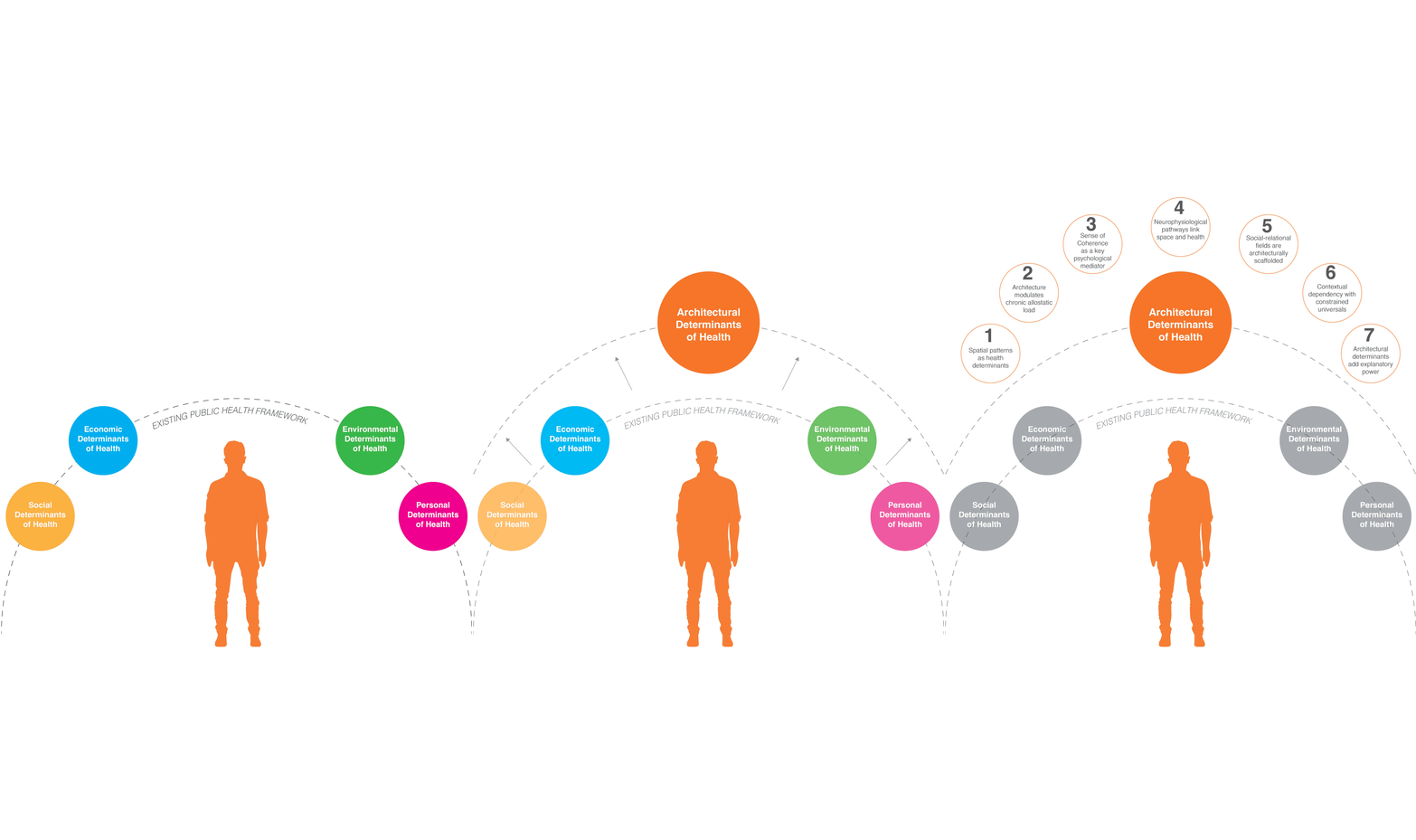
Positioning the ADoH Theory Into Other Determinants of Health Frameworks
The Architectural Determinants of Health Theory is nestled within existing determinants of health paradigms articulated by the World Health Organisation (WHO), the Public Health Agency of Canada (PHAC), and related Social Determinants of Health (SDH) frameworks.
WHO and PHAC identify a broad set of personal, social, economic, and environmental determinants, including social and structural determinants that shape the conditions in which people are born, grow, live, work, and age. ADoH refines the physical, environmental, housing, and urban design components by specifying how the architectural qualities of everyday settings act as primary, measurable determinants of health through psychological, neurophysiological, and social relational pathways, over and above traditional determinants. ADoH fits cleaning inside the existing determinants of health landscape as a more specific, spatially focused theory that complements – rather than replaces – social, environmental, economic, and structural determinants frameworks.

How ADoH Can Be Embedded in Existing Public Health Frameworks
Existing public health frameworks provide ready-made “slots” where ADoH can be inserted:
In determinants lists (e.g., PHAC, WHO, CDC), ADoH provides a sub-framework under “physical environments” or “housing/urban planning,” specifying architectural determinants and mechanisms.
In SDH conceptual frameworks (e.g., WHO’s structural vs. intermediary determinants), ADoH offers a set of intermediary built-environment pathways that can be diagrammed alongside material circumstances, psychosocial stressors, behaviours, and the health system.
In population health promotion models and “who/what/how” cubes, ADoH populates the “what” (architectural determinants) and informs the “how” (architectural and planning interventions) for sectors such as education and health care.