
Neurospatial Health
Neurospatial health is a state or dimension of human health arising from the ongoing interaction between neurological processes and spatial conditions. It is an umbrella term for the object of study shared across a rapidly expanding set of named fields: neuroarchitecture, neuroaesthetics, neurourbanism, environmental neuroscience,
neurosustainability, architectural epidemiology, and dozens more.
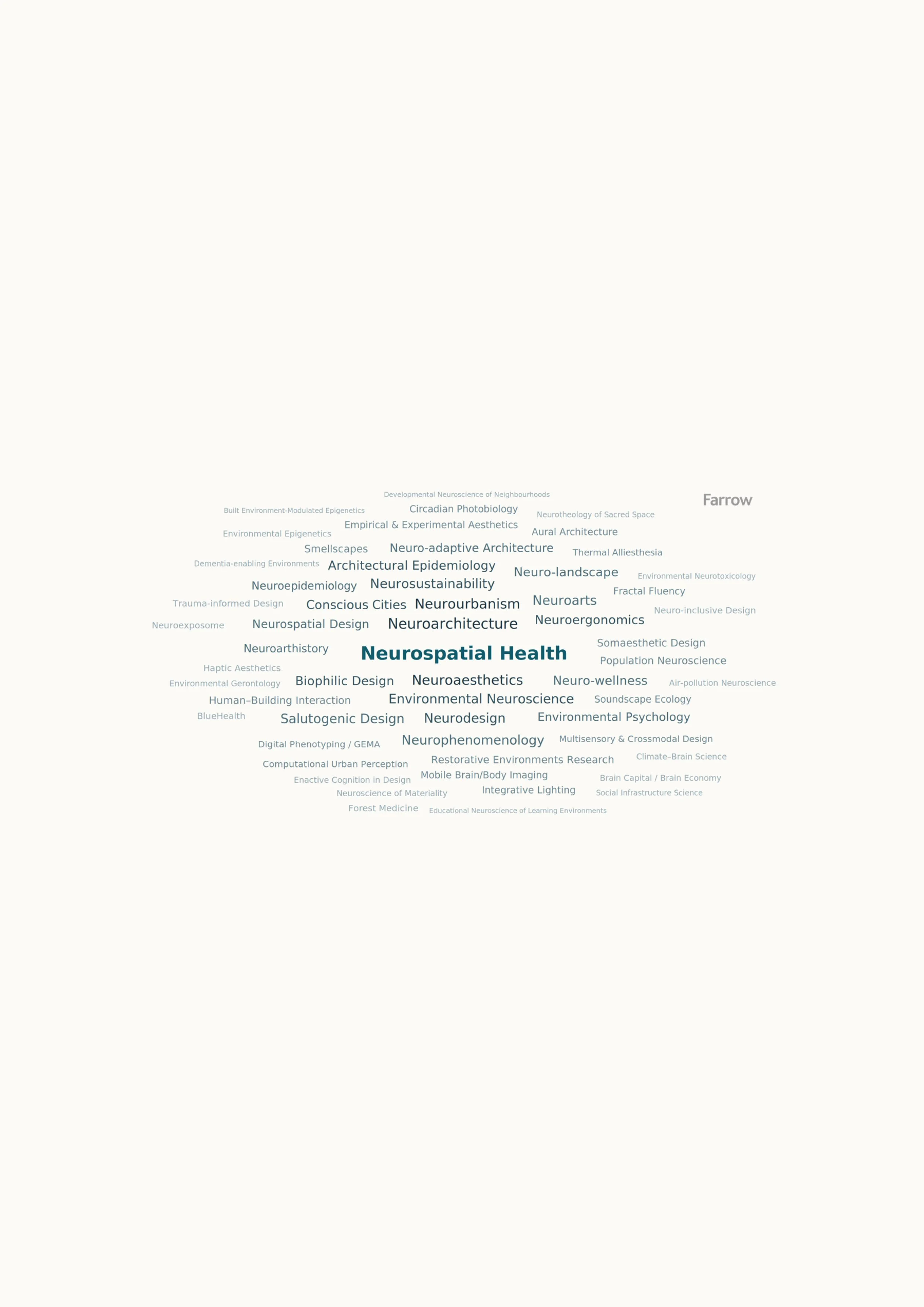
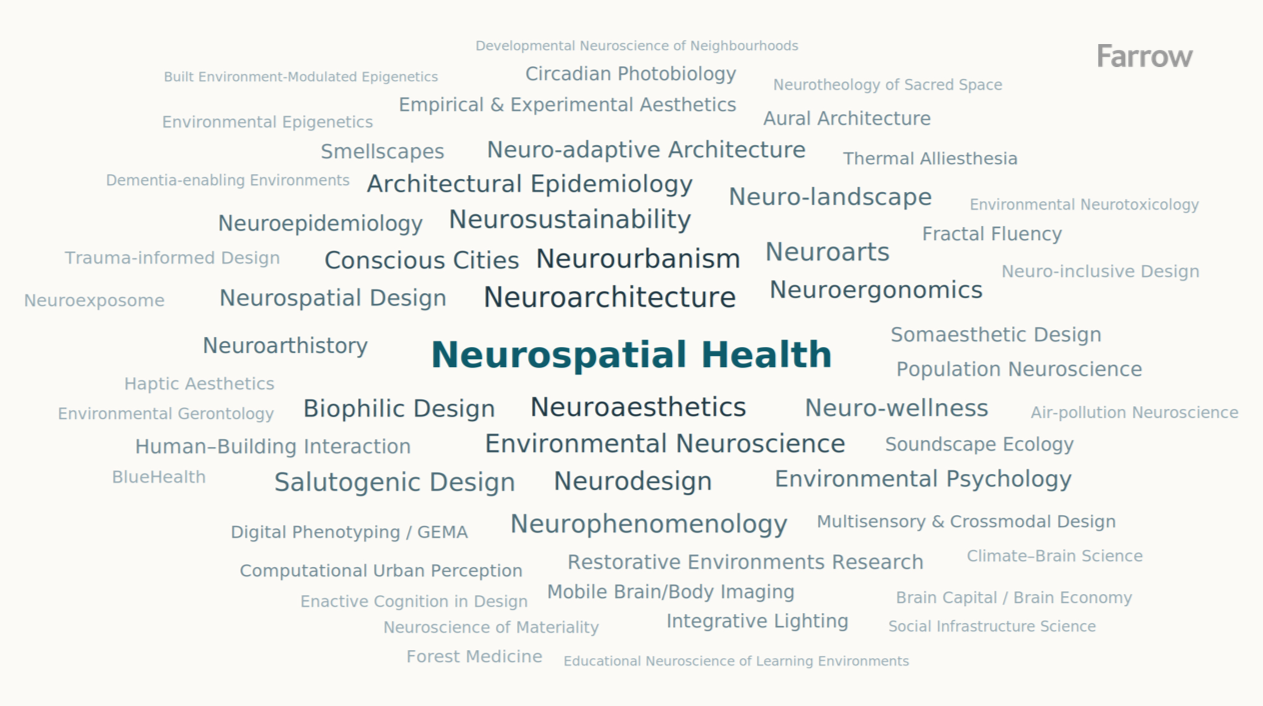
The map below sets out 56 named territories, including fields, methods, and research programmes, currently working this ground. That count is the evidence that the umbrella is needed.
Neurospatial health is not a new theory, and it is not intended to displace any of these. It names what they are all already studying.
Where the term came from
The term came out of our field-mapping rather than invention. Read side by side, these labels are not competing disciplines. They are one argument sliced along four axes:
1. Scale: the level at which the environment is measured, from the material surface to the metropolitan region.
2. Modality: the channel through which it acts: visual, acoustic, thermal, configurational, social, symbolic.
3. Population: where its effects appear: clinical, occupational, developmental, general.
4. Instrument: what made observation possible: EEG, fMRI, cortisol assay, space syntax, epidemiological cohort, computational image analysis.
Each addresses some portion of a common object, differing chiefly in where it locates the cause: in the site, in the environment’s capacity for enrichment, in the chronicity of exposure, or in the isolated stimulus.
What the area has lacked is a name for what all of them share.
Distinguishing neurospatial health from adjacent terms
Environmental neuroscience is the closest existing candidate for an umbrella. As commonly defined, it is organized around its instruments and its explanatory claims are typically pitched at the neural level. Neurospatial health is organized around its object of study and carries its claims through to health outcomes accumulated over a life course.
Neurospatial design is a closely related term now in active use, and the two are not synonyms. The term has been taken up substantially over the past year: the Pedersen Foundation has established neurospatial design as one of its four grantmaking focus areas; the Milken Institute’s Science Philanthropy Accelerator for Research and Collaboration, working with the Pedersen Foundation, published Bridging Neuroscience, Health, and the Built Environment: A Giving Smarter Guide (2026) framing it as an emerging field; and the Global Brain Economy Summit programmed it as a theme for its September 2026 meeting.
The distinction is straightforward and, we would argue, useful to both terms:
Neurospatial design is a design approach informed by neuroscience and health evidence.
Neurospatial health is a state or dimension of human health arising from the interaction between neurological processes and spatial conditions.
One describes what designers do; the other describes what people experience. A field building agenda needs both: the practice and the object the practice acts upon.
The object in three terms
Neuro: the cognitive, affective, and physiological responses through which the body registers its surroundings
Spatial: the conditions and interactions of the environments we move through, including objects, buildings, and landscapes, in which those responses are provoked, sustained, or relieved.
Health: the recognition that these responses are not merely experiential but consequential, accumulating over time to degrade or enhance physical health, mind health, and wellbeing.
Put plainly: the way our bodies and emotions steady or strain in response to the spaces we live and work in every day, and what that does to our health over a lifetime.
Why not simply “good design”?
Because good design is an endorsement, not an explanation. It tells you that someone with authority liked a building. It does not tell you what was operating, on whom, through which pathway, or with what consequence. It cannot be falsified, cannot be measured across sites, and cannot be entered into a model alongside income, housing tenure, or neighbourhood deprivation.
An umbrella term is only useful if it points at something that can be specified and tested which is where the theory does the work the name cannot.
The Relationship to Architectural Determinants of Health (ADoH)
Neurospatial health names the object; ADoH specifies and tests it.
ADoH is a domain-specific, middle-range public health theory positioned within WHO,
PHAC, and social determinants of health frameworks. It treats architecture as the translation layer through which structural determinants, including the unequal distribution of power, money, and resources, become lived, measurable physiological, psychological, and social experience. It sits deliberately downstream of those determinants; it does not relocate root causes into design.
Where neurospatial health is a name, ADoH supplies the machinery that makes the name accountable:
Feature-based specification. Environments are characterized not as typologies (“urban versus rural,” “nature versus built”) but as multi-dimensional profiles across four interrelated families of properties: perceptual-sensory, spatial-configurational, contextual social-organizational, and symbolic meaning-identity.
A continuum, not a verdict. The spatial friction-traction continuum replaces the good/bad binary. High friction increases cognitive effort and uncertainty; high traction makes affordances legible and reachable. Both are, in principle, measurable.
Named mediators. Sense of coherence, allostatic regulation, cumulative affective load, cognitive reallocation, social-relational scaffolding, and neurophysiological pathways, where each is specified as a channel rather than asserted as an effect.
Falsifiability. Seven propositions, each advanced at a stated evidentiary level and each accompanied by boundary conditions describing what result would weaken or defeat it. The framework is built to be disconfirmable, including where its more speculative extensions, such as the built environment-modulated epigenetics (BEME) hypothesis, remain hypotheses rather than established mechanisms.
That last point is the reason the umbrella term matters practically rather than rhetorically. If these 56 territories are studying one object, their findings should be commensurable, and where they are not, we should be able to say precisely which axis the disagreement sits on.
The Relationship to Constructing Health
Constructing Health: How the Built Environment Enhances Your Mind’s Health (University of Toronto Press, 2024) is the practice-side precursor to this work. It argued three things that ADoH and the neurospatial health framing both inherit.
First, that there is no such thing as neutral space: what we build either causes health or undermines it.
Second, that architecture can operate as a non-invasive therapeutic agent, a “nutrient rich” environment rather than a benign container.
Third, that mind health is the right term, deliberately chosen over mental health, because it carries an asset-based, salutogenic orientation concerned with what actively generates wellbeing rather than a deficit-based, pathogenic view organized around the absence of illness.

The book asked the salutogenic question: what causes health? It answered through built work, neuroscience, and case study. What it did not do, and did not claim to do, was specify the mechanisms tightly enough to be tested, or position the argument inside the determinants-of-health frameworks that public health actually uses. ADoH is that next step.
Neurospatial health is the shorthand name for the terrain both are working on.
What the term is, and what it is not
It is a shorthand, an anchor, and a way of drawing greater clarity into these discussions. It is a way of specifying what we actually mean when we say a building is good.
It is not a new discipline, not a claim of priority over adjacent frameworks, and not an explanation in itself. An umbrella term earns its place only if the work underneath it becomes more comparable, more cumulative, and more falsifiable than it was before. That is the test we would want applied to it.