
Matured Gardens at Colchester East Hants Communicate A Sense of Coherence
“Revisiting the Colchester East Hants Health Centre a few years after completion offers a meaningful perspective on how architecture performs over time” – Tye Farrow
Colchester East Hant Health Centre is a 124-bed hospital located in Truro, Novas Scotia. Designed in collaboration with WHW Architects, the health care centre supports medical, surgical, palliative, mental health, critical care, emergency, and ambulatory support.
Its design integrates variety, vitality, and curiosity, featuring a generous linear circulation route rather than a traditional main lobby. The route links, skirts along, and bisects a number of exterior garden courtyards, like beads on a necklace. This means that views to nature and access to sun and fresh air are never out of reach for patients, families, and staff.
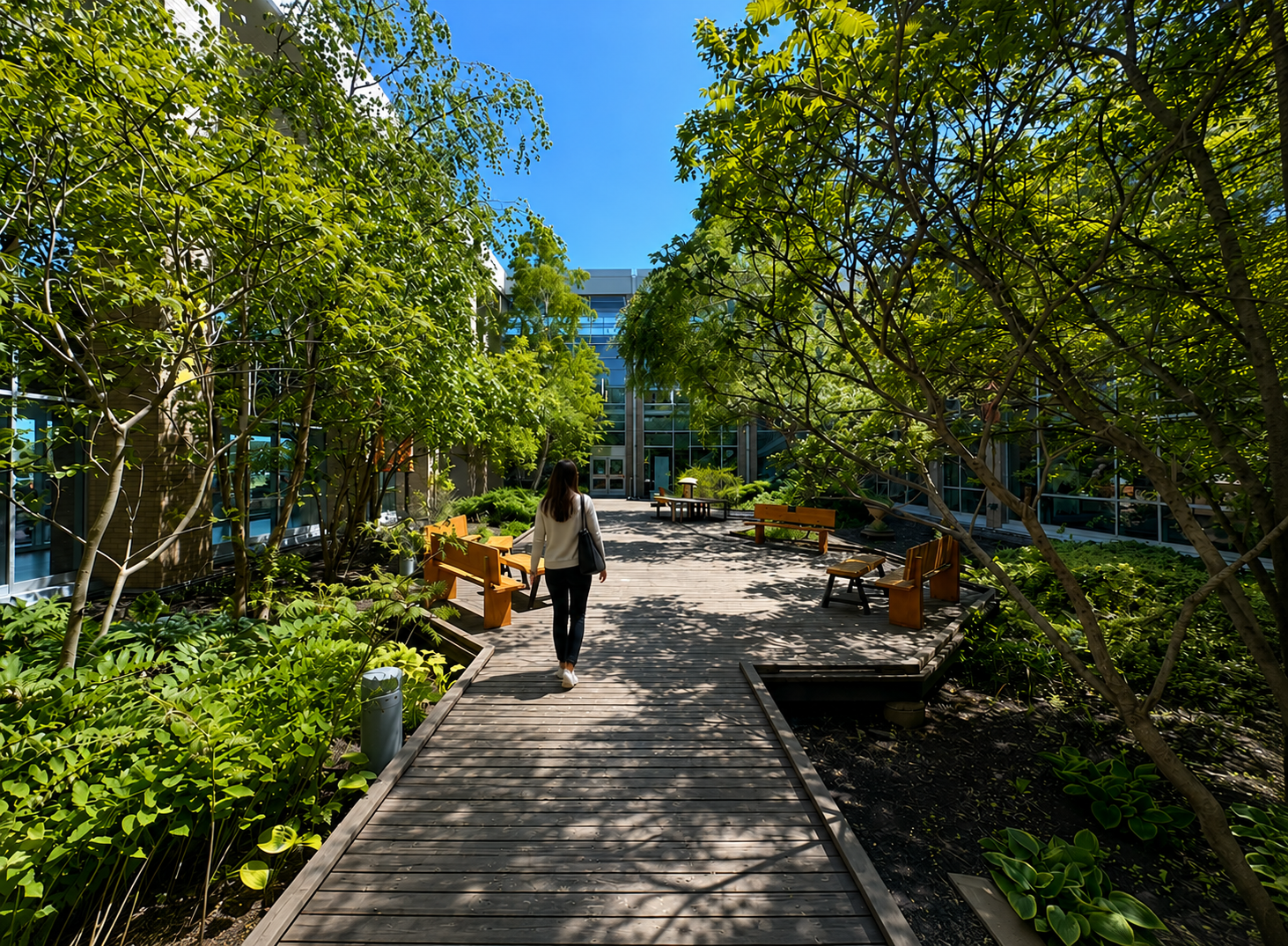
Photograph of Colchester East Hants Health Centre in 2026, photographed by Tye Farrow
Access to nature has proven to benefit human mind and body health and even increase healing speeds. Cognitive brain function, brain activity, blood pressure, mental health, physical activity, and sleep patterns are all aspects of health that improve when exposed to nature[1]. Integrating nature into healing spaces such as hospitals can therefore enhance health, leading to the creation of a salutogenic built environment. Potted plants, views to surrounding nature, daylight, natural materials, and natural forms are all types of natural architectural design.
At Colchester East Hants, wood panels span the walls of patient rooms, tree-like columns line the wide circulation route, and lush green courtyards are speckled throughout the facility to integrate nature within the hospital’s design.
Over time, the courtyards at Colchester have flourished and grown to offer patients, families, and staff a more engulfing natural space. The timber walkway now appears to float atop a bed of green shrubs while fluffy green bundles of branches offer shade and protection above. The branches act as natural curtains, providing privacy from the semi-public courtyards to the more private hospital interior.
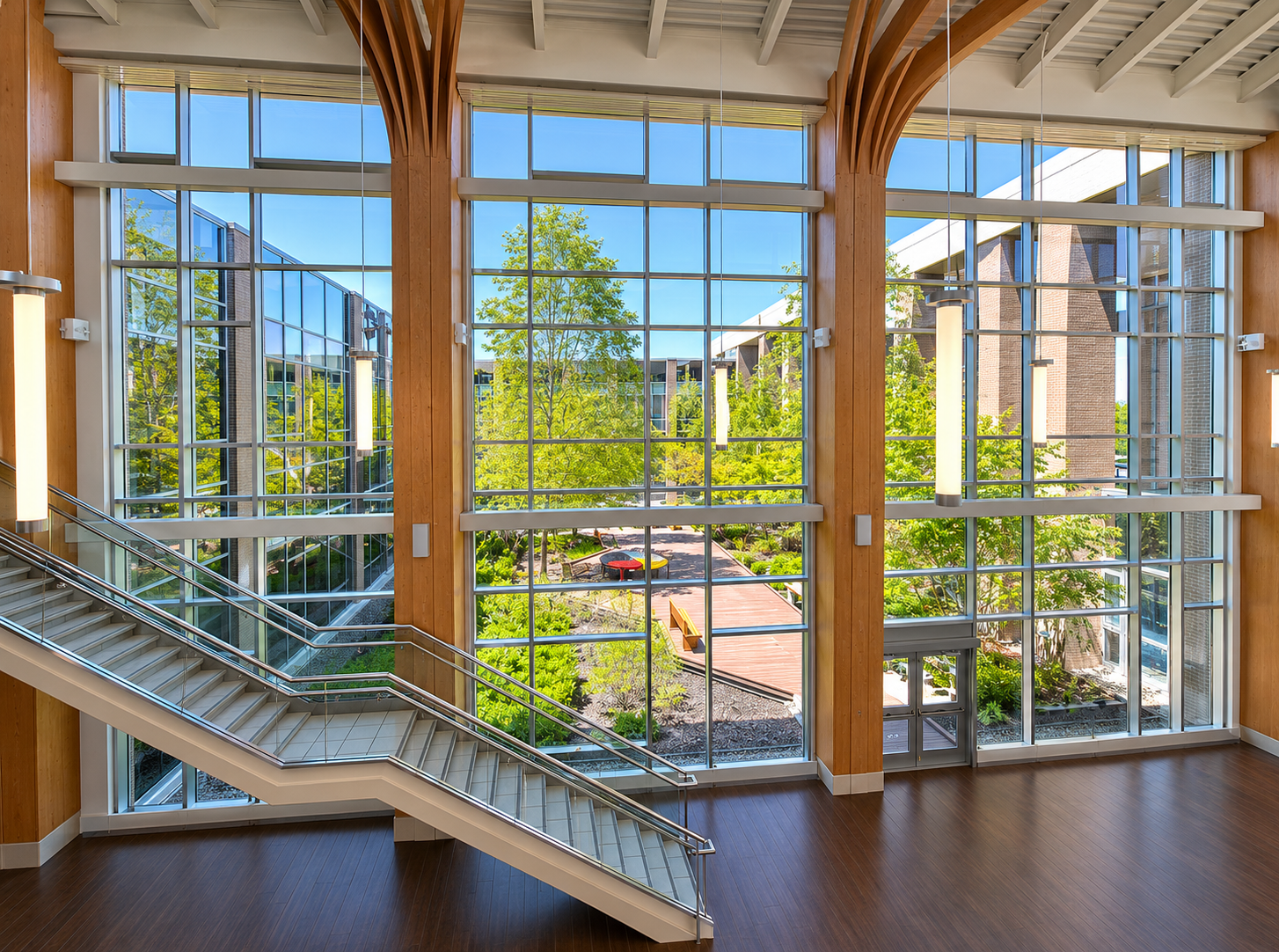
Photograph of Colchester East Hants Health Centre in 2026, photographed by Tye Farrow
When space is able to reflect its time and age, it communicates that the environment is resilient, enduring, and meaningful. Shapes, forms, and symbols that can display a sense of reality and rootedness – for example the growth of trees in the Colchester courtyards – can lead to a positive emotional response which comes from understanding these forms as authentic. A University of Toronto study form 2013 finds that “inpatients culture” reduces happiness, those exposed to a natural scene were instead exhibiting higher degrees of happiness than those exposed to a McDonalds fast-food cup[2].
Spatial authenticity can lead to comprehensibility and manageability of space which in turn creates a sense of coherence. Just as the older and more developed trees in the Colchester courtyard can communicate growth, they also remind us that life is manageable and meaningful. In times of high stress, these reminders can stimulate health and wellbeing to make a healing journey much more tolerable.
[1] Jimenez, M. P., DeVille, N. V., Elliott, E. G., Schiff, J. E., Wilt, G. E., Hart, J. E., & James, P. (2021). Associations between Nature Exposure and Health: A Review of the Evidence. International journal of environmental research and public health, 18(9), 4790. https://doi.org/10.3390/ijerph18094790
[2] Julian House, Sanford E. DeVoe, and Chen-BoZhong, “Too Impatient to Smell the Roses: Exposure to Fast Food Impedes Happiness,” Social Psychological and Personality Science 5, no. 5 (July 2014): 534–41, https://doi.org/10.1177/1948550613511498.