
Architectural Influence on Brain Wave Activity
Architecture is not neutral, the spaces we inhabit either undermine or enhance our health.
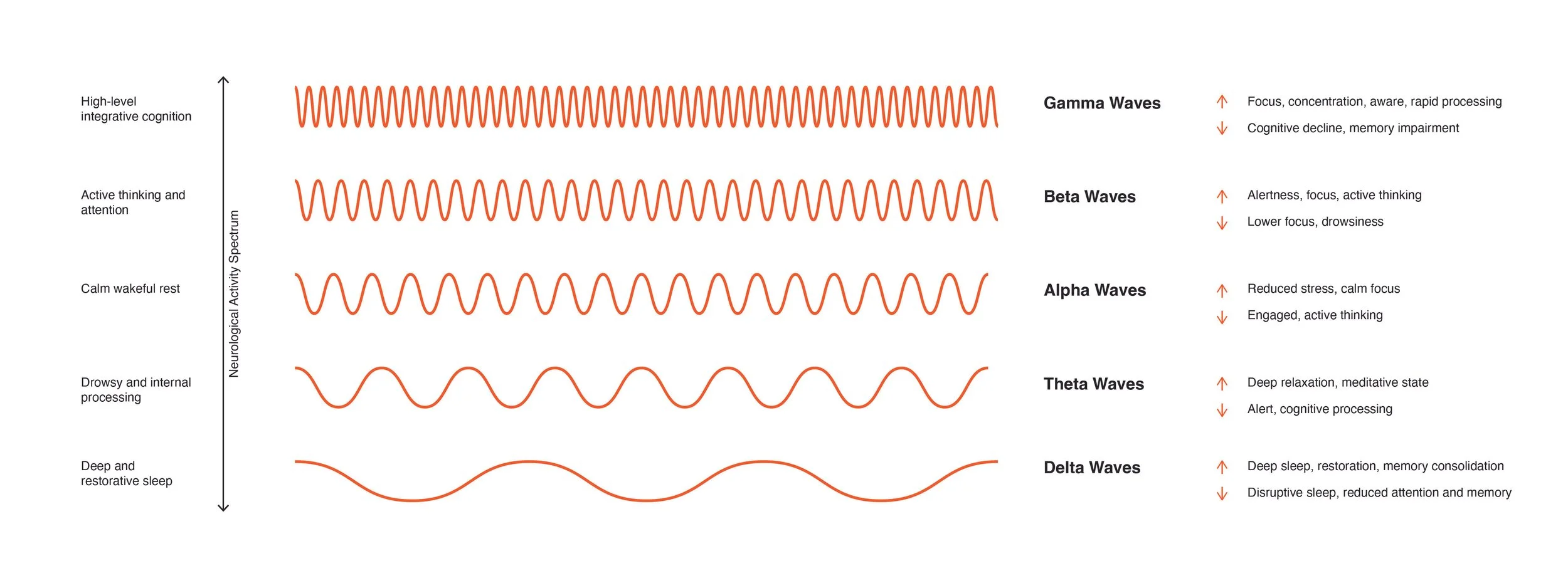
Brain wave activity and cognitive outcomes diagram
The brain experiences oscillating electrical voltages that can be categorised into five types and read using electrodes (sensors) and an electroencephalogram (EEG)[1]. Delta, theta, alpha, beta, and gamma brain frequencies are rhythmic electrical patterns that reflect how awake, relaxed, focused, or deeply unconscious the brain is. From sleeping (delta) through deeply relaxed and inwardly focused (theta), to very relaxed passive attention (alpha), to active external attention yet relaxed (beta), to concentration (gamma)[2].
Brain frequencies are influenced by internal and external stimuli – including architecture – which ultimately influences human activity levels and excitement. The design of the built environment can therefore be leveraged to tune human brain frequencies, choreographing space to enhance health and wellbeing.
Beta brain frequencies indicated alertness, focus, and active thinking while alpha waves indicate a state of calm wakeful rest. By enhancing alpha and theta brain wave activity, a meditative yet engaged mental state can be achieved. Fractal mid-range patterns – commonly found in trees, clouds, and mountains – can be easily observed and processed by the human eye due to its frequency in nature[3]. When observing mid-range fractals, such as trees and clouds, alpha and beta waves peak which leads to a wakeful and relaxed state with heightened attention[4]. By translating nature’s fractal patterns into architecture, similar results can be manifested to cause health.
At the Lauremont School Bayview Campus, this neuroarchitectural phenomenon is exercised in the entrance atrium. The gentle bend of the semi-circular arches coincides with the bursting tree-branch-like timber beams to create fractal patterns inspired by nature. The awe-striking canopy of timber members fosters a calming and engaging learning environment for students, educators, and visitors of the Montessori school campus.
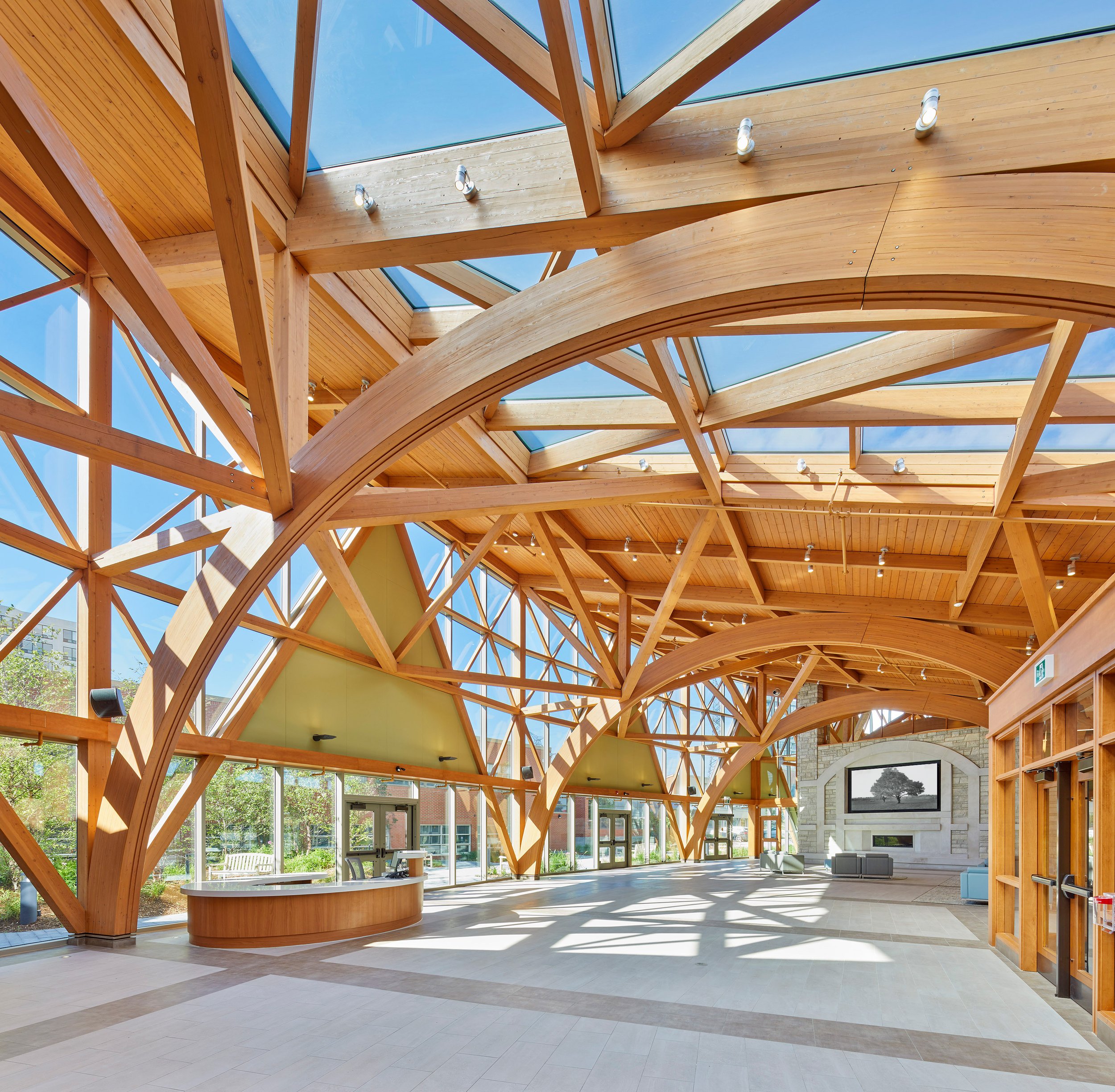
Entrance building at Lauremont School Bayview Campus, by Tom Arban
Brain frequencies can also be triggered by auditory stimulation. An investigation into the effects of auditory stimulation in a wooden house showed that light floor impact increased alpha and theta waves[5]. This brain frequency alteration can lead to inward focus and passive outward attention and an overall relaxing state.
Several healthcare projects by Farrow Partners – such as Helmsley Cancer Centre, Credit Valley Hospital, and Sechelt Hospital – feature an abundance of wood to generate a multisensory health generating environment. At Sechelt, the entrance atrium features a wood feature stair that ascends next to the timber sun mural by Sechelt artist Shain Jackson. This creates an opportunity for auditory stimulation via footsteps on the wood stair treads to increase alpha and theta waves. This effect in a healthcare environment, such as a hospital, can help relieve anxiety and encourage relaxation for staff, visitors, and patients who are likely engaged in high-stress treatment.
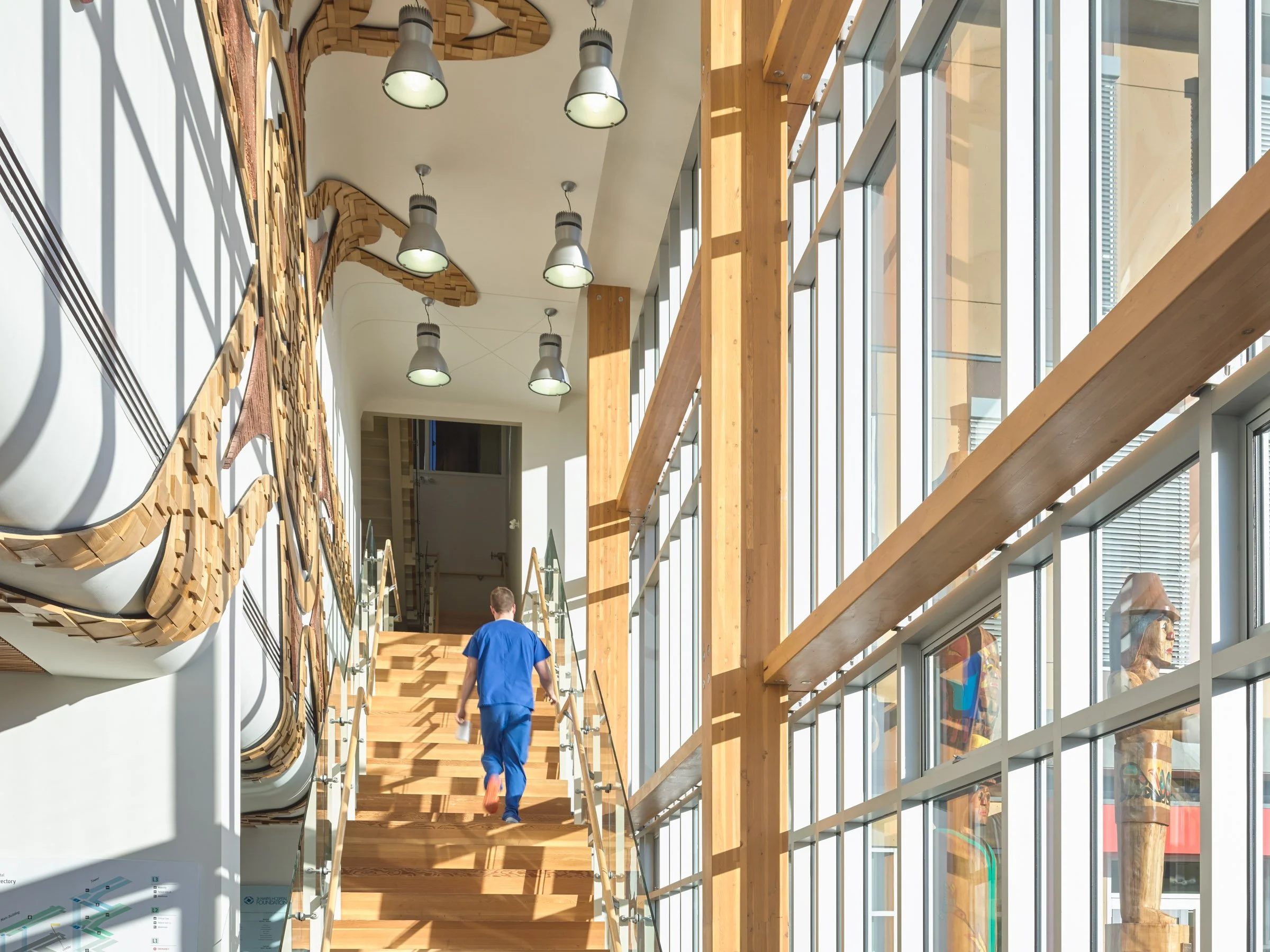
Wood stairs at the Sechelt Hospital, by Latreille Delage Photography
The stimulation of brain frequencies can enhance human health and generate desirable mental states. Focus and engagement can be achieved in educational facilities, and relaxation can be achieved in healthcare environments using strategic architectural design choices. Architecture is not neutral, the spaces we inhabit either undermine or enhance our health. By tuning architecture to the brain’s frequencies, health can be achieved and maintained throughout the built environment.
[1] Priyanka A. Abhang, Bharti W. Gawali and Suresh C. Mehrotra, “Technological Basics of EEG Recording and Operation of Apparatus,” in Introduction to EEG – and Speech-Based Emotion Recognition, (Academic Press, 2016), 15-50.
[2] Abhang, Gawali and Mehrotra, “Technological Basics of EEG Recording and Operation of Apparatus,” 15-50.
[3] Richard P. Taylor, “The Potential of Biophilic Fractal designs to Promote Health and Performance: A Review of Experiments and Applications,” Sustainability 13, no. 823 (2021): https://doi.org/10.3390/su13020823
[4] Taylor, “The Potential of Biophilic Fractal Designs.”
[5] Harumi Ikei, Chorong Song, Yoshifumi Miyazaki, “Physiological effects of wood on humans: a review,” Journal of Wood Science 63, (2017), 1-23.