
Neurospatial Health
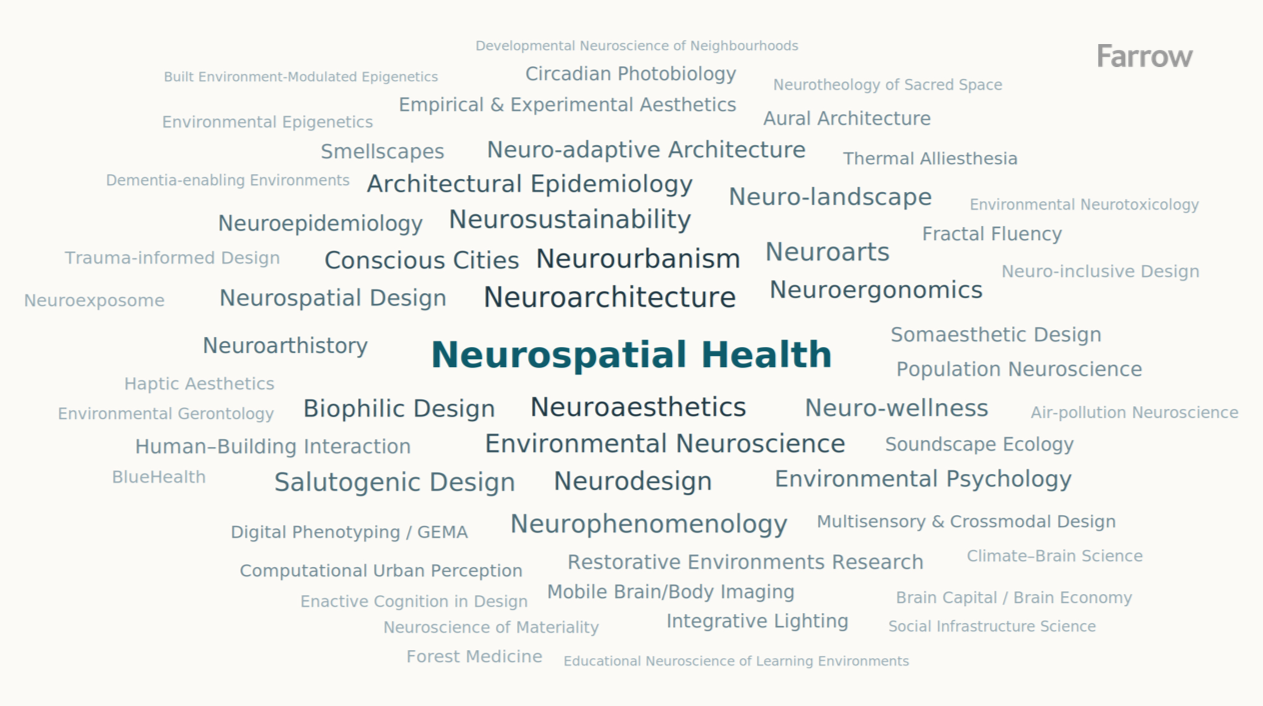
Neurospatial Health is an umbrella term for the object of study shared across the rapidly expanding set of named research fields like neuroarchitecture, neuroaesthetics, neurourbanism, environmental neuroscience, neurosustainability, architectural epidemiology, and dozens more. The term, developed by Tye Farrow, has emerged in an attempt to gather a collection of 56 named territories including fields, methods, and research programmes. The term aims not to replace any of the territories within the following map, but instead to name their object of study.
Neurospatial design is a closely related term now in active use, and the two are not synonyms. The term has been taken up substantially over the past year: the Pedersen Foundation has established neurospatial design as one of its four grantmaking focus areas; the Milken Institute’s Science Philanthropy Accelerator for Research and Collaboration, working with the Pedersen Foundation, published Bridging Neuroscience, Health, and the Built Environment: A Giving Smarter Guide (2026) framing it as an emerging field; and the Global Brain Economy Summit programmed it as a theme for its September 2026 meeting. Where neurospatial design is a design approach, neurospatial health is a state or dimension of human health arising from the interaction between neurological processes and spatial conditions.
The Architectural Determinants of Health model has been developed by Tye Farrow throughout his doctoral studies at the University of Toronto. The ADoH model specifies neurospatial health and tests it, providing the machinery to hold the name object of study accountable.
To learn more about Neurospatial Health, visit the knowledge hub here.